How to Check Your Car's Oil (Without Looking Like an Idiot)
Domain specialist and verified guide author at HowToHub.
🎯 Quick Guide Summary & Core Answer
Here is the direct answer on how to check your car's oil (without looking like an idiot) in 5 sequential steps:
⚡ TL;DR / Key Takeaways
- Follow a structured, expert-verified sequence of 5 steps to successfully check your car's oil (without looking like an idiot).
- Focus on the critical milestones: Park on flat ground and wait and Check the color and consistency.
- Read the fact-checked tips and warnings to avoid common pitfalls during execution.
Step-by-Step Instructions
Park on flat ground and wait
If you check your oil while parked on a steep driveway, the oil in the engine pan will slosh to one side, giving you a completely inaccurate reading. Always park on a level surface. Also, do not check the oil immediately after driving a long distance. When the engine is running, the oil is pumped up into the top of the motor. You need to turn the car off and wait about five to ten minutes for all that oil to drain back down into the pan at the bottom. This ensures you are measuring the total volume.
Find the brightly colored dipstick
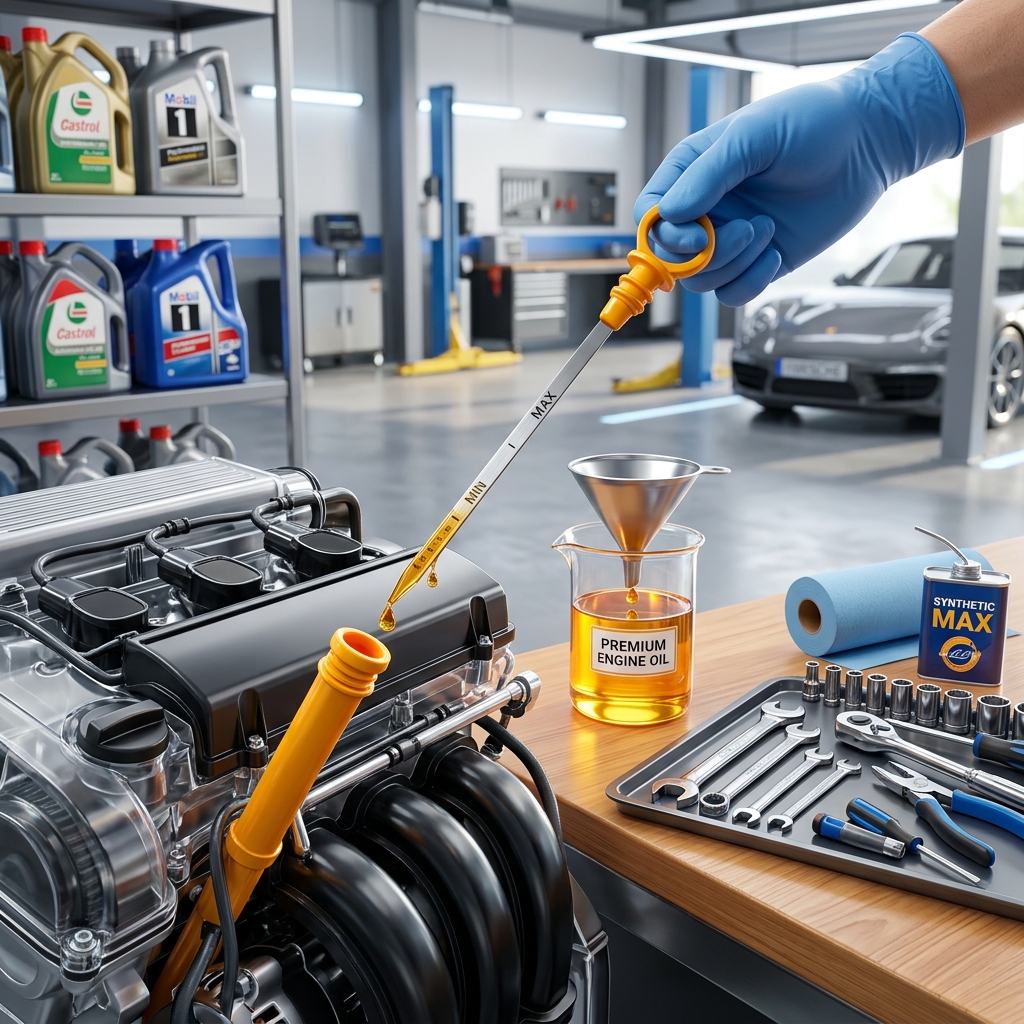
Pop the hood of your car. (If you don't know how, there is usually a lever under the steering wheel, and a secondary safety latch under the front lip of the hood itself). Look at the engine. You are searching for a small ring or handle that is usually painted bright yellow or orange. It often has the word 'OIL' stamped on it, or a picture of an old-fashioned oil can. This is the dipstick. Grab it and pull it straight up. It will be a long, flexible piece of metal.
Wipe it completely clean and put it back
This is the step everyone forgets. When you pull the dipstick out the first time, it will be covered in oil from the engine splashing around. You cannot read it yet. Take a clean paper towel or an old rag and wipe the metal stick completely clean from top to bottom. Once it is shiny and clean, slide it all the way back down into the tube it came from. Make sure it clicks or pushes all the way down to the base.
Pull it out again and read the level
Now, pull the dipstick out a second time. Hold it horizontally so the oil doesn't run up or down the stick and ruin the reading. Look at the very bottom tip. You will see two marks. They might be two small holes, the letters 'L' and 'F' (Low and Full), or a crosshatched pattern. The film of oil should end right between those two marks. If it is right in the middle or near the top mark, your oil level is perfect.
Check the color and consistency
While you are looking at the level, look at the oil itself. Fresh engine oil is a transparent, amber color, like honey. As it does its job cleaning the engine, it gets darker. If it is dark brown or black, that's completely normal for older oil, but it means you are due for an oil change soon. If the oil looks thick, sludgy, or milky like a coffee frappuccino, put the dipstick back and call a mechanic immediately—a milky texture means engine coolant is leaking into the oil system.
Was this step-by-step guide helpful?
Your feedback helps us keep our guides accurate and clear.
📚 Authority Sources & Citations
This step-by-step guide is aligned with references and verification guidelines from the following trusted authorities: